




Proof of Performance
Automation Speed
Products Categorized in Under 60 Seconds
DecisionRules automatically re-categorizes products within 60 seconds of any attribute change. This ensures Boohoo’s listings remain accurate and up to date across millions of products without manual intervention.
Operational Efficiency
Saved the Equivalent of 2 Full-Time Employees
By replacing manual categorization workflows in Salesforce, Boohoo reduced reliance on IT and saved the equivalent of two full-time employees, generating approximately £150,000 in annual cost savings.
Enterprise-Scale Processing
Up to 10 Million Product Updates per Day
DecisionRules scales seamlessly with Boohoo’s vast product portfolio, processing up to 10 million product data changes daily and supporting consistent categorization across brands and sales channels.
The Challenge
Prior to implementing DecisionRules, Boohoo's product categorization was heavily dependent on manual processes within Salesforce. This approach was not only labor-intensive but also prone to inefficiencies, making it challenging to keep up with the scale and pace of Boohoo's operations. The company needed a solution that could automate the categorization process, reduce reliance on the IT team, and allow non-technical staff to manage categorization rules effectively.
The Solution
Boohoo explored several options, including open-source rule engines, but ultimately selected DecisionRules for its intuitive user interface and robust capabilities. DecisionRules provided a plug-and-play solution that met Boohoo's needs for quick deployment and easy management by business users. The decision to use DecisionRules was driven by its ability to handle complex categorization tasks through an API, without requiring extensive database configurations or custom development.
Implementation
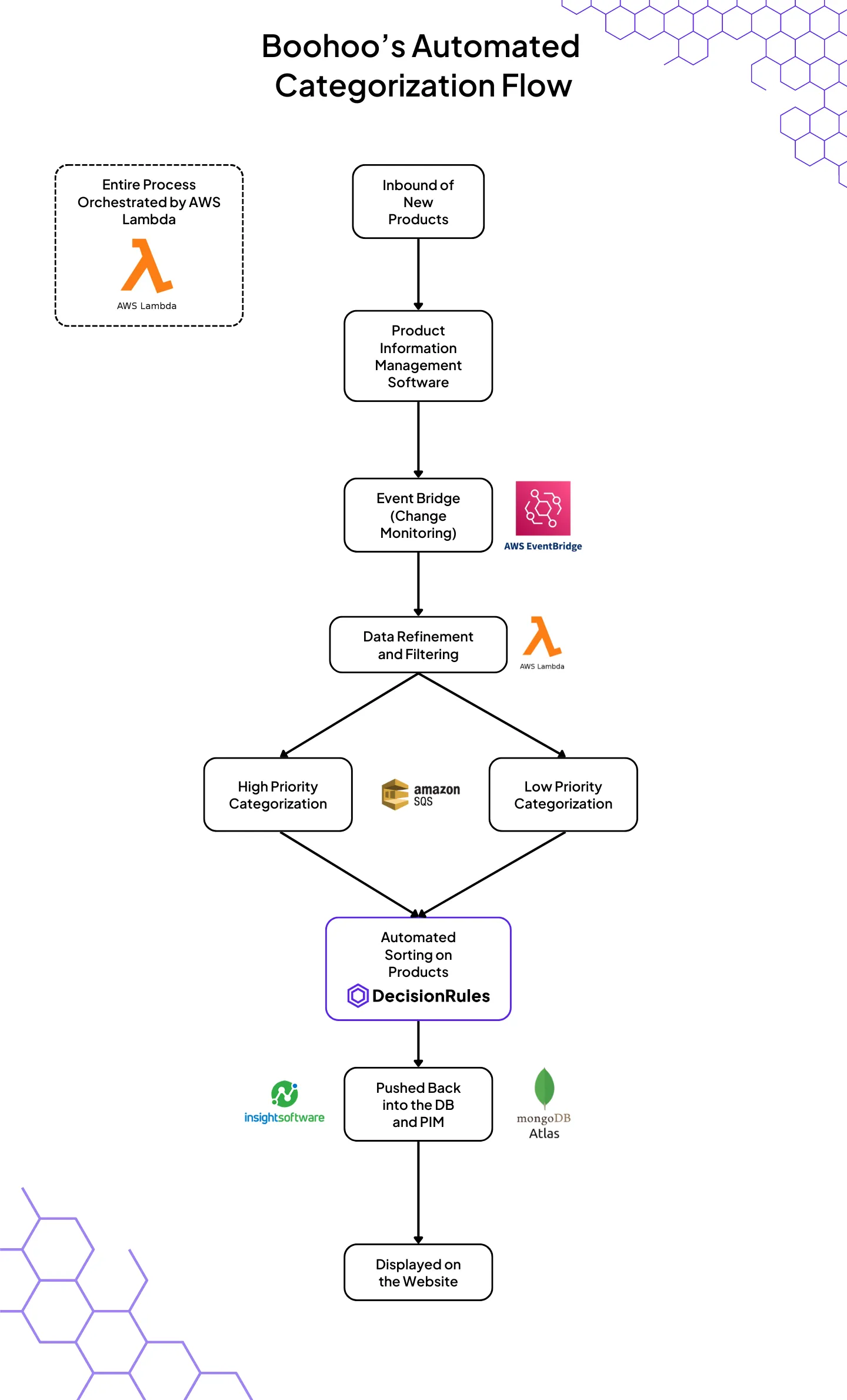
The implementation of DecisionRules at Boohoo was rapid and efficient. The Minimum Viable Product (MVP) was operational within days, and the full setup of rules in the DecisionRules engine took only two to three weeks. Boohoo's serverless application, Thundercat, integrates seamlessly with DecisionRules, utilizing AWS services like Lambda, EventBridge, and API Gateway to automate the categorization process.
Use Cases
- Automated Product Categorization:
- Process: Boohoo's Product Information Management (PIM) system feeds product data, including hundreds of attributes, into DecisionRules. The system processes these attributes to determine the best categories for each product, enhancing Boohoo's categorization capabilities.
- Impact: The automated system categorizes products within 60 seconds of any attribute change, ensuring that Boohoo's product listings are always up-to-date and accurate.
- Multi-Platform Integration:
- Boohoo plans to extend DecisionRules across multiple e-commerce platforms, including Amazon and TikTok. By mapping platform-specific categories into DecisionRules, Boohoo can ensure consistent and accurate categorization across all sales channels, improving product visibility and sales potential.
Results and Impact
- Efficiency Gains: DecisionRules has automated Boohoo's categorization process, reducing the need for manual intervention and freeing up IT resources. This has allowed Boohoo to focus on more strategic initiatives, improving overall operational efficiency.
- Cost Savings: Automating the categorization process with DecisionRules has saved Boohoo the equivalent of two full-time employees, resulting in savings of approximately £75,000 per employee per year.. These cost reductions, along with increased efficiency, are providing a significant return on investmentScalability: DecisionRules has proven capable of handling the categorization needs of Boohoo's extensive product portfolio, processing up to 10 million product data changes daily.
Future Outlook
Boohoo plans to scale the use of DecisionRules across additional platforms and brands and explore further applications beyond product categorization. By leveraging DecisionRules' capabilities, Boohoo aims to drive even greater efficiencies and enhance its competitive edge in the global fashion market.
Conclusion
The implementation of DecisionRules at Boohoo Group has changed the way the company manages its product categorization, delivering significant efficiency gains, cost savings, and scalability. This successful partnership positions Boohoo for sustained growth and continued success in the dynamic fashion industry.
With DecisionRules, Boohoo has empowered its non-technical teams to manage complex rules independently, reducing reliance on IT and enabling faster, more accurate categorization across all its brands and platforms.

Bracey Parr is a DecisionRules Expert, where he works closely with organizations to design, implement, and optimize scalable decision automation systems. He has nearly 10 years of experience in transforming complex, hard-coded business workflows into high-performing, transparent rule engines, enabling companies to decouple their operational logic from legacy software and move at the speed of modern business.